
What I Believe
These are the core convictions that shape my message, my writing, and my ministry. I share them plainly so that you know where I stand and so that those searching for grace-filled truth can find it clearly.
The Gospel
The gospel is the good news that we are made right with God by grace through faith in Jesus Christ alone—not by works, performance, or religious effort. Salvation is God's gift, secured by Jesus’ finished work on the cross, and received by faith. We cannot earn, deserve, or maintain God’s acceptance by our obedience. Salvation is not a law-based formula we perform to make ourselves right with God. Christ's finished work is sufficient to secure our forgiveness, acceptance, peace with God, and right standing before Him.
Scripture: Romans 3:20-24; Romans 5:1-2; Romans 5:8; Romans 8:1; Galatians 2:16; Galatians 3:10-14; Ephesians 2:8-9; Titus 3:4-5; 2 Corinthians 5:21; Philippians 3:9
The Father’s Heart
I believe the Father’s heart toward those who are in Christ is love, not condemnation. He is not waiting for us to prove ourselves before He accepts us. He acted first. While we were still sinners, Christ died for us. His love for us is unconditional. It is not earned, and it is not withdrawn every time we fail. It is received. Performance-based faith distorts the way we see the Father’s heart toward us, but grace restores our vision of who He truly is.
Scripture: Romans 5:8; Romans 8:15-16; 1 John 3:1; Luke 15:11-32; Psalm 103:8-14; Isaiah 30:18
Righteousness
I believe righteousness is received, not achieved. Christ Himself is our righteousness. When we begin to rely on our obedience to maintain God's acceptance, we may still say we trust God, but we are no longer resting in Christ alone to make us right with Him. In many places, that framework is preached as obedience to the law of God—but whatever we call it, it cannot justify us (or make us right with God), and it cannot heal the heart. Performance-based faith fractures the soul.
Scripture: 2 Corinthians 5:21; Philippians 3:9; Romans 3:21-22; Romans 4:4-5; Romans 9:30-32; Galatians 2:21; Galatians 5:4
Obedience
I believe obedience matters. Holiness matters. Transformation matters. But obedience is the fruit of a heart made right with God—not the way we make ourselves right with Him. We do not obey in order to become righteous. We obey because, in Christ, we have been made right with God. True obedience flows from love, trust, and the Spirit's work within us, not from fear, pressure, or the need to prove ourselves acceptable to God.
Scripture: John 15:4-5; Romans 6:1-2; Galatians 5:6; Ephesians 2:10; James 2:14-26; 1 John 5:3
Healing and Transformation
I believe real transformation comes from the Lord. Prayer, fasting, repentance, obedience, and seeking help all matter—but none of those things, in themselves, have the power to heal the heart apart from Christ. The Holy Spirit is the one who transforms us, little by little, from one degree of glory to another. Healing is a process, not a performance. It is led by the Spirit, not driven by pressure, fear, or shame. True healing brings us into deeper alignment with the Father’s heart, the heart of the gospel of Jesus Christ, and the true condition of our own heart.
Scripture: 2 Corinthians 3:18; John 6:63; Zechariah 4:6; Galatians 3:3; Philippians 1:6; Philippians 2:12-13; Psalm 147:3
The Holy Spirit
I believe the Holy Spirit is the breath of God—Pneuma (πνεῦμα)—the Spirit who gives life, restores, and makes new. He is the one who heals what performance cannot fix. He brings people alongside us in community, gently surfaces what needs healing in His wisdom and care, and sets the pace of our healing—bone by broken bone, breath by healing breath.
Scripture: Genesis 2:7; John 20:22; John 6:63; Romans 8:11; Romans 8:26-27; 2 Corinthians 3:17-18; Galatians 5:22-23
Community
I believe God designed His people for community, not isolation. Isolation is not the same as healing. But a caged community is still a cage. We need gospel-centered community—a family where we don't have to perform to belong and a Father whose love we don’t have to earn. We need community where grace is told clearly, truth is handled faithfully, and belonging is not earned by performance.
Scripture: Genesis 2:18; Hebrews 10:24-25; Galatians 6:2; Romans 12:4-5; 1 Corinthians 12:12-26; James 5:16
The BROKEN RIBS Message
I believe many sincere believers are carrying hidden spiritual fractures — wounds caused by legalism, performance-based faith, shame, and a distorted understanding of righteousness. Like a broken rib, these fractures affect everything connected to them: how we love, how we trust, how we receive grace, and how we breathe in the presence of God.
But I also believe grace does not just forgive the heart. It heals the heart. God heals what performance cannot fix—bone by broken bone, breath by healing breath.
Scripture: Psalm 34:18; Psalm 147:3; Isaiah 53:5; Isaiah 61:1; Ezekiel 37:5-6; Matthew 11:28-30; 2 Corinthians 3:18
A Word About Ministry
I am not speaking as someone who has arrived. I am still on the healing journey. The message I share is not theory—it is what God has been teaching me through fracture, wilderness, and grace. My prayer is that what God is doing in me will help others recognize the wounds they have carried in silence, find language for the pain, and discover that healing is possible—and it may be as close as their next breath.
Stop striving. Start breathing.
Resources for Discernment
Below are two resources to help you discern truth and find freedom.
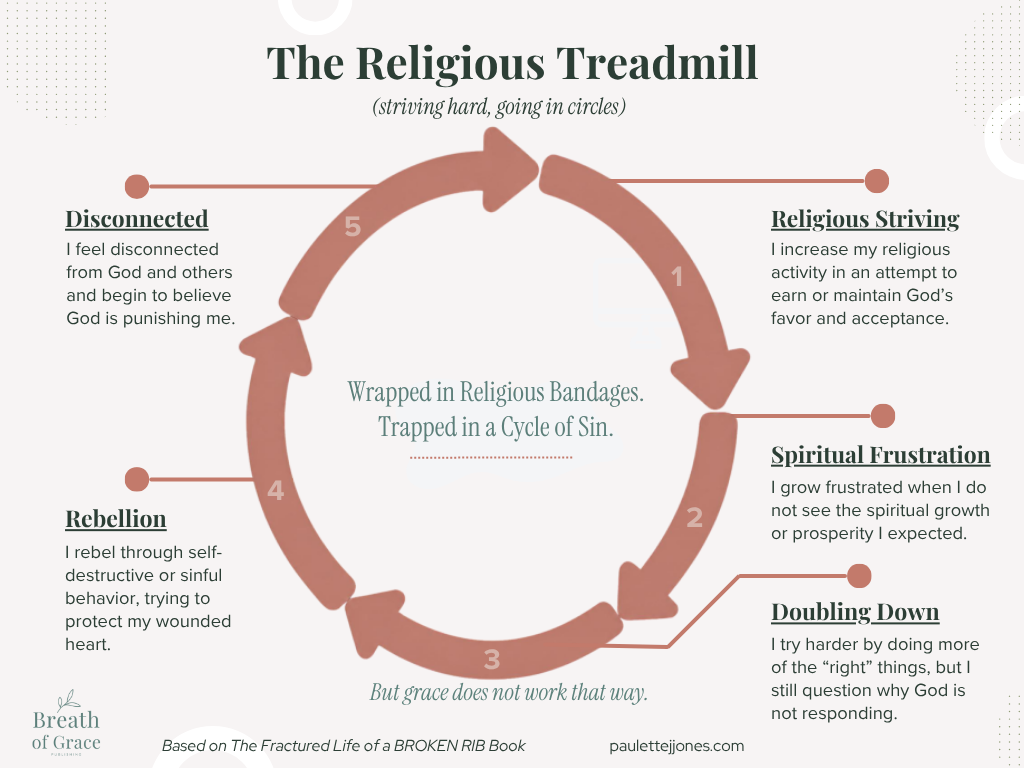
The Religious Treadmill
A visual tool to help you recognize the cycle of performance-based faith—how striving, measuring, and comparing keep you exhausted and stuck, rather than resting in the finished work of Christ.
Download the Treadmill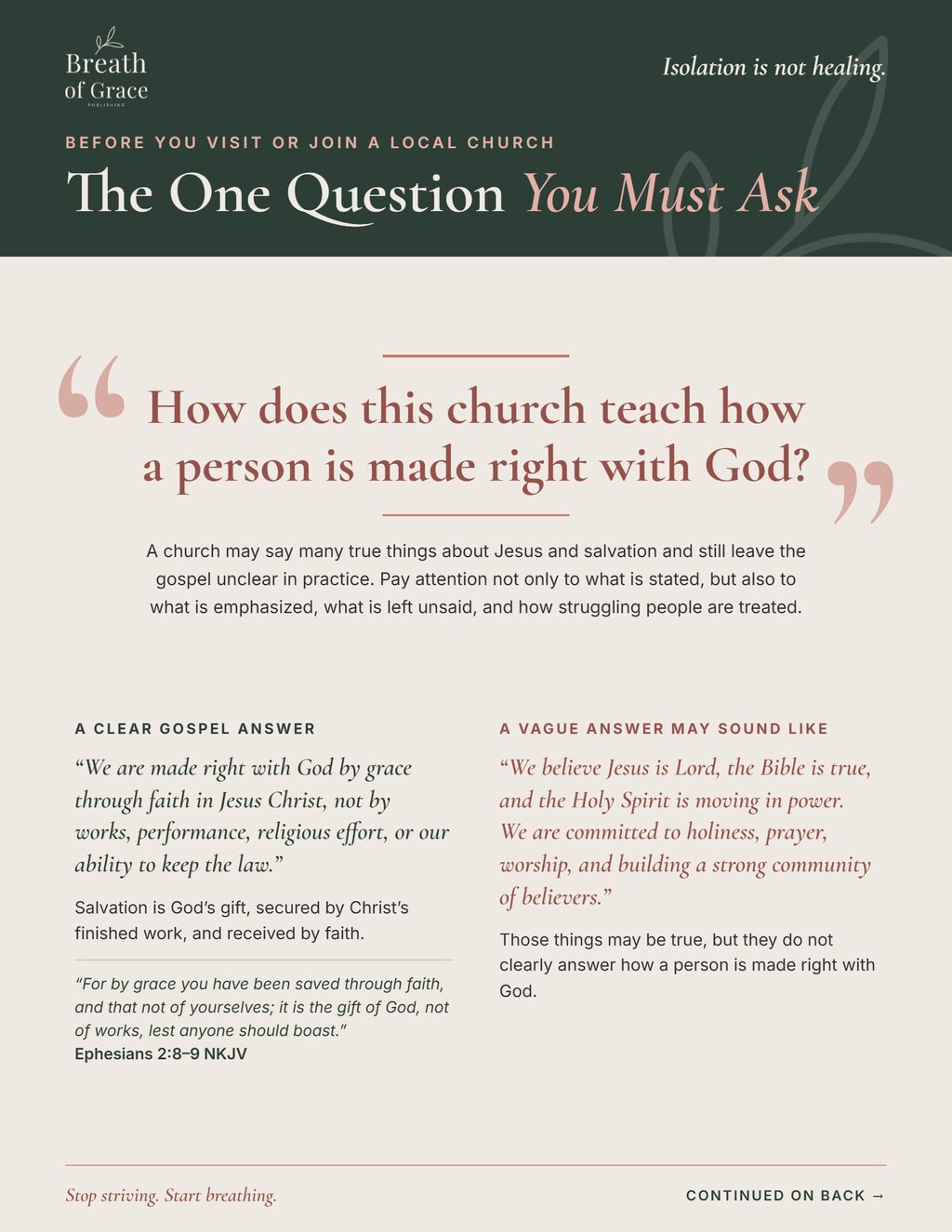
The One Question You Must Ask
A practical guide to help you discern whether a church teaches the gospel clearly—the one question to ask, a clear gospel statement, red flags to watch for, and language for a gracious exit if needed.
Download the Guide